
UV flatbed technology has reshaped the sign and decoration industry over the past decade, but many production teams still underutilize their machines. The most common complaint is consistent: great results on one material, disappointing results on another. The truth is, a UV flatbed printer is not a one-setting-fits-all tool. Different substrates demand dedicated ink formulas, print profiles and pre-treatment routines to deliver factory-grade finish.
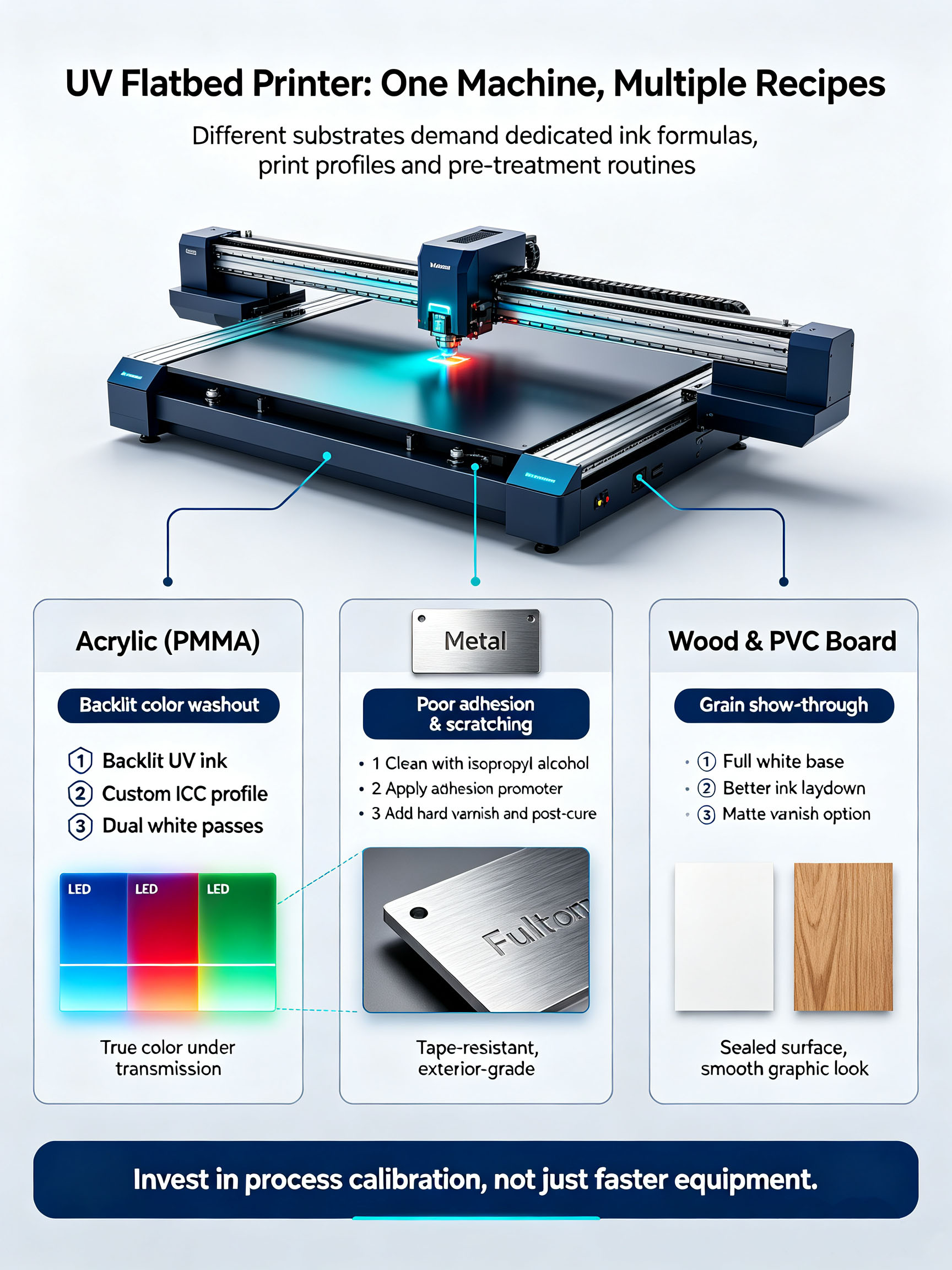
Acrylic: Fix Backlit Color Washout
Acrylic light boxes are the highest-margin product for most sign shops, yet standard UV prints often look faded and washed out once backlit. The issue is not the printhead — it is that default color profiles are calibrated for surface viewing, not for light transmission.Proven solution:
• Use a dedicated backlit UV ink set with balanced color saturation under LED transmission
• Apply a custom ICC profile calibrated specifically for backlit viewing conditions
• Layer white ink in two controlled passes to avoid light leakage while keeping brightness uniform
Sample: Backlit acrylic panel printed with dedicated backlit UV profile, showing true color accuracy under LED illumination
Metal: Solve Adhesion and Scratch Resistance
Aluminum signage and stainless steel nameplates are tough applications for UV printing. Without proper preparation, ink can peel off with tape or chip during fabrication.
Proven solution:
• Wipe the surface with isopropyl alcohol and apply a thin, even coat of metal adhesion promoter before printing
• Use a hard, scratch-resistant top coat (matte or gloss OP varnish) for exterior-grade durability
• Run a post-cure pass to ensure full cross-linking of the ink layer
Sample: Brushed aluminum nameplate printed with Ricoh Gen6 printhead, with clear overcoat for industrial weather resistance
Wood & PVC Board: Eliminate Grain Show-Through
Rough substrates like MDF, plywood and PVC foam board often show surface texture through the print, ruining the smooth graphic look.
Proven solution:
• Print a full white base layer first to seal the surface and create a uniform foundation
• Reduce carriage speed slightly on the first color pass to improve ink laydown on uneven surfaces
• For textured wood grain finishes, use a matte varnish to enhance the natural tactile feel
For production managers, the biggest return on investment comes not from buying a faster machine, but from matching the right process to each material. A well-calibrated UV flatbed setup can handle acrylic, metal, wood, glass and ceramic all on one machine — if you run them with the right recipe.
Post time: Sep-17-2026


